-

snub dodecahedron
JPY 7,800(USD 49.44)
SOLD OUT
It is one of Archimedean solids. The size is about 50 mm in diameter. Made of Japanese cypress. Beeswax finish.
-

great rhomb-icosi-dodecahedron
JPY 5,800(USD 36.76)
It is one of Archimedean solids. The size is about 50 mm in diameter. Made of Japanese cypress. Beeswax finish.
-

rhomb-icosi-dodecahedron
JPY 5,800(USD 36.76)
SOLD OUT
It is one of Archimedean solids. The size is about 50 mm in diameter. Made of Japanese cypress. Beeswax finish.
-

icosi-dodecahedron
JPY 3,000(USD 19.02)
It is one of Archimedean solids. The size is about 50 mm in diameter. Made of Japanese cypress. Beeswax finish.
-

snub cube
JPY 3,500(USD 22.18)
It is one of Archimedean solids. The size is about 54 mm in diameter. Made of Japanese cypress. Beeswax finish.
-

great rhomb-cub-octahedron
JPY 3,000(USD 19.02)
It is one of Archimedean solids. The size is about 54 mm in diameter. Made of Japanese cypress. Beeswax finish.
-
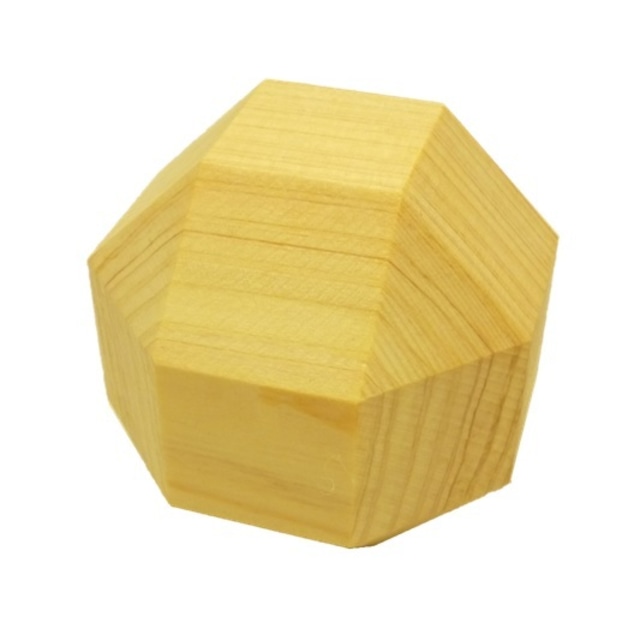
rhomb-cub-octahedron
JPY 2,500(USD 15.85)
It is one of Archimedean solids. The size is about 54 mm in diameter. Made of Japanese cypress. Beeswax finish.
-
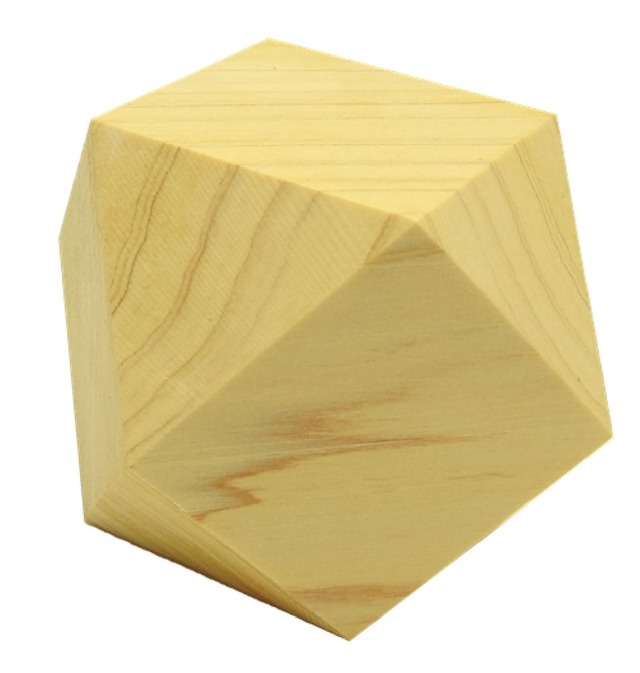
cub-octahedron
JPY 2,200(USD 13.94)
It is one of Archimedean solids. The size is about 54 mm in diameter. Made of Japanese cypress. Beeswax finish.
-

truncated icosahedron
JPY 3,000(USD 19.02)
It is one of Archimedean solids. The size is about 50 mm in diameter. Made of Japanese cypress. Beeswax finish.
-

truncated dodecahedron
JPY 2,500(USD 15.85)
It is one of Archimedean solids. The size is about 50 mm in diameter. Made of Japanese cypress. Beeswax finish.
-

truncated octahedron
JPY 2,200(USD 13.94)
It is one of Archimedean solids. The size is about 54 mm in diameter. Made of Japanese cypress. Beeswax finish.
-

truncated cube
JPY 2,200(USD 13.94)
It is one of Archimedean solids. The size is about 54 mm in diameter. Made of Japanese cypress. Beeswax finish.
-

truncated tetrahedron
JPY 2,200(USD 13.94)
It is one of Archimedean solids. The size is about 54 mm in diameter. Made of Japanese cypress. Beeswax finish.
-

wood octahedron
JPY 1,800(USD 11.41)
regular octahedron size: 53x53x74 mm Japanese cypress beeswax finish
-

wood tetrahedron
JPY 1,800(USD 11.41)
regular tetrahedron edge size: 55 mm Japanese cypress beeswax finish
-

wood icosahedron
JPY 2,200(USD 13.94)
regular icosahedron size: 50x50x46 mm Japanese cypress beeswax finish
-

wood dodecahedron
JPY 2,000(USD 12.68)
size: 54x54x46 mm Japanese cypress(beeswax finish), walnut, white oak, red oak, cherry (vernish finish)
-

WOOD PLATONIC SOLIDS
JPY 5,000(USD 31.69)
Wooden regular polyhedron model(Platonic solids) Regular tetrahedron, cube, regular octahedron, regular dodecahedron, regular icosahedron Each size is about 5 cm Made of Japanese cypress, beeswax finish, or vernish finish, or no wax Produced by Japanese woodworker Hiroshi Nakagawa
-

'Wooden Polyhedra English edition'
JPY 1,500(USD 9.51)
"Wooden Polyhedra"(English edition) How to make wooden polyhedra written by Hiroshi Nakagawa & Ikuro Sato translated by Jon Flory Schrock Chapter 1 At woodworking, the fundamental process primarily possible on a cube is called "chamfering." Chamfering is possible at various angles. Another one of the processes possible secondarily is "truncating." In this chapter, I will how to develop all regular polyhedra and semiregular polyhedra from cubes by combining "chamfering" and "truncating." Platonic solids cube tetrahedron octahedron dodecahedron icosahedron Archimedean solids truncated tetrahedron cub-octahedron truncated octahedron truncated cube icosi-dodecahedron truncated dodecahedron rhomb-icosi-dodecahedron great rhomb-icosi-dodecahedron truncated icosahedron great rhomb-cub-octahedron rhomb-cub-octahedron snub cube snub dodecahedron Polytopes the 120-cell in 4 dimensions the 600-cell in 4 dimensions 64pages Contents 1 Basics of Polyhedron Woodworking Techniques 1.1 Chamfering a cube Meeting of a woodcrafter for a hobby and a mathematics lover The fun of chamfering cubes Woodworking procedures for chamfering cubes 1.2 From chamfering to truncating Changing the depth of chamfering (rhombic dodecahedron) Changing the angle of chamfering (hexagonal prism) Truncating based on chamfering (truncated octahedron) Variations in truncated cube 1.3 Chamfering with the golden ratio Mastery of chamfering and truncating (regular icosahedron) Impressive regular dodecahedron 1.4 Combination between chamfering and truncating Truncation of a golden ratio system Truncation of a regular tetrahedron Chamfered truncated dodecahedron Chamfered truncated cube The most difficult twisting off 2 The fun of constructing wooden polyhedra 2.1 Construction of chamfered cubes (extracted) 2.2 Variety of the space-filling polyhedra (extracted) 2.3 Three-dimensional projection models of 4-polytopes Development of four-dimensional 600-cell building blocks 3 Let's enjoy cutting the Platonic solids from styroform cubes (omitted)
-

WOODEN POLYHEDRA 20
JPY 55,000(USD 348.61)
SOLD OUT
Wooden models of regular and quasi-regular polyhedra 5 types of Platonic solids + 15 types of Archimedean solids (including 2 types of mirror images) With special case The size of each polyhedron is about 5 cm Made of Japanese cypress, beeswax finish
-

Truncated octahedron space-filling model
JPY 6,000(USD 38.03)
Voronoi diagram of body-centered cubic lattice One of five types of solids that Fedorov called parallelohedra The size is almost 3 cm, set of 14 Made of Japanese cypress
-

Rhombic dodecahedron space-filling model
JPY 6,000(USD 38.03)
Voronoi diagram of face-centered cubic lattice One of five types of solids that Fedorov called parallelohedra The size is almost 3 cm, set of 14 Made of Japanese cypress
-

Elongated rhombic dodecahedron space-filling model
JPY 6,000(USD 38.03)
Voronoi diagram of cubic pyramids One of five types of solids that Fedorov called parallelohedra The size is almost 3 cm, set of 14 Made of Japanese cypress